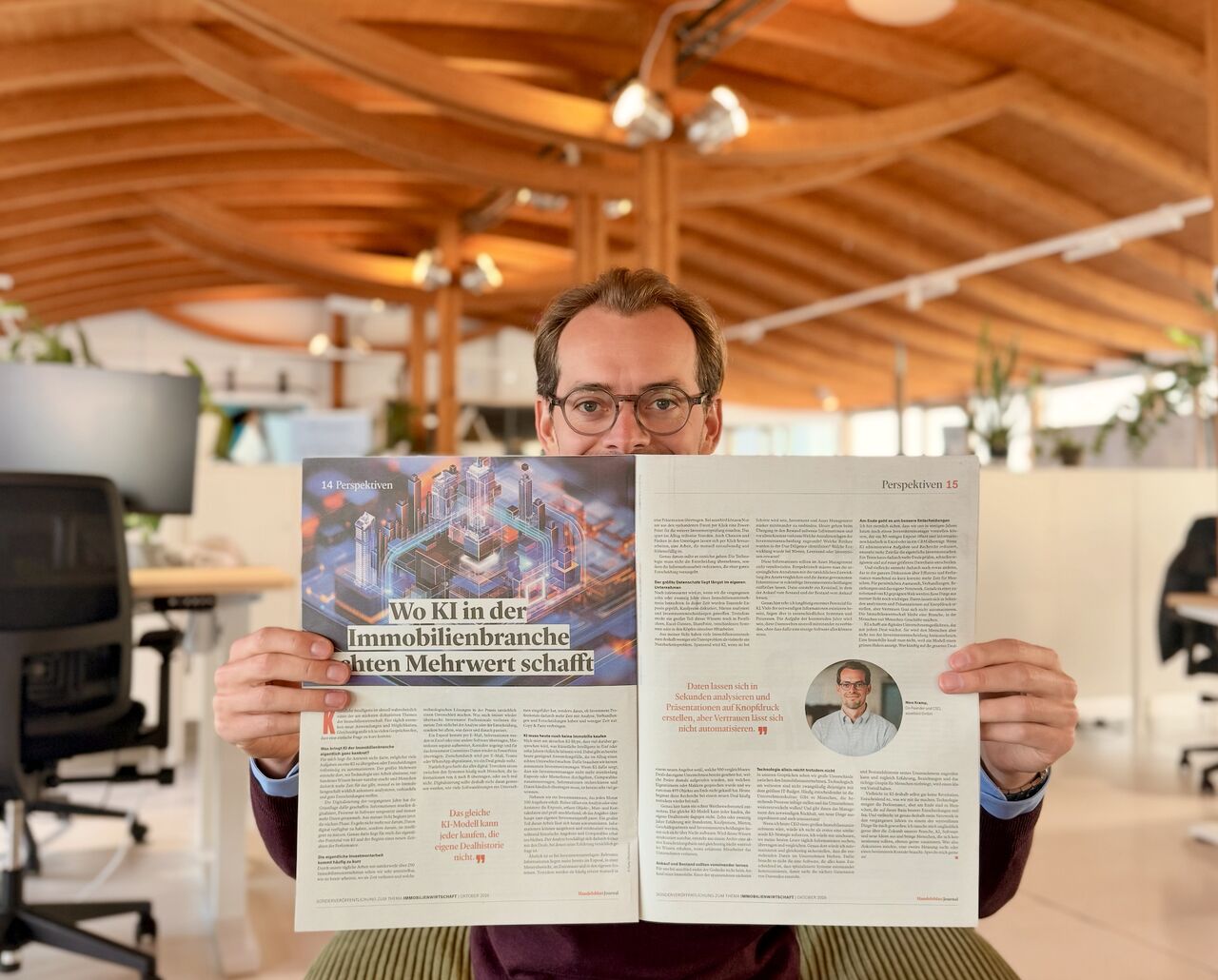
Artificial intelligence is one of the most talked-about topics in the real estate industry. New applications are emerging almost daily, but one question often gets overlooked: What concrete benefits does AI offer the industry today? In the October issue of the Handelsblatt Journal, “Real Estate Industry: New Foundations,” assetbird co-founder and CSO Nico Kramp answers precisely this question, drawing on his daily work with over 250 real estate companies.
The full article as a PDF
Handelsblatt Journal: Real Estate Industry, October 2026, pages 14 and 15
Download PDF ↓An Overview of the Key Points
- Time for Investment Work Instead of Copy & Paste: Investment professionals don't spend most of their time on analysis or decision-making, but rather on transferring information between email, Excel, CRM, and PowerPoint.
- AI doesn't need to buy real estate today: Real added value is already being created when property listings, tenant lists, and comparables are automatically parsed and structured.
- Your own deal history as a competitive advantage: AI models are available to everyone. Decades of verified offers, purchase prices, and decisions, however, are not.
- Integrating Acquisitions and the Investment Portfolio: Assumptions made during the investment decision-making process should be carried forward into asset management so that both areas can learn from each other.
- Culture Trumps the IT Budget: What matters most are people who question processes and a management team that supports them.
Less Information Work, Better Decisions
A property overview arrives via email, data is transferred to Excel, tenant lists are prepared separately, and then converted back to PowerPoint for the Investment Committee. Everything is done digitally, and yet there are often still people sitting between the systems, copying information from A to B. For Nico Kramp, therefore, digitalization should not be measured by the number of tools implemented, but rather by how much time teams regain for analysis, negotiations, and decision-making.
Here's an example: An investment team receives 100 proposals every month. Much of the data entry and preliminary screening can now be automated, while historical proposals and comparables are retained. This allows the analyst to focus sooner on the deals where his or her experience is truly needed.
The greatest treasure trove of data lies within your own company
Over the course of ten or twenty years, a real estate company reviews thousands of property listings. However, this knowledge is often scattered across email inboxes, Excel files, SharePoint, or the minds of individual employees. Many companies therefore face less of a data problem than a usability problem. If this knowledge is made accessible in a structured way, an archive can become an active basis for decision-making that remains intact even when experienced employees leave the company.
Anyone can buy the same AI model, but not their own trading history.
Trust cannot be automated
Despite all the efficiency gains, one thing remains clear to Nico Kramp: AI does not replace people in the investment decision-making process. It creates a digital corporate memory that grows with every deal, giving teams more time for what really matters in the real estate business: personal interaction, negotiations, and relationships. The real estate industry remains a sector where people do business with people.